
How A3 and A4 Relate: Imposition, Bleed & Scaling
Understand the mathematical relationship between A3 and A4 paper for booklet imposition, bleed allowances, and scaling factors.
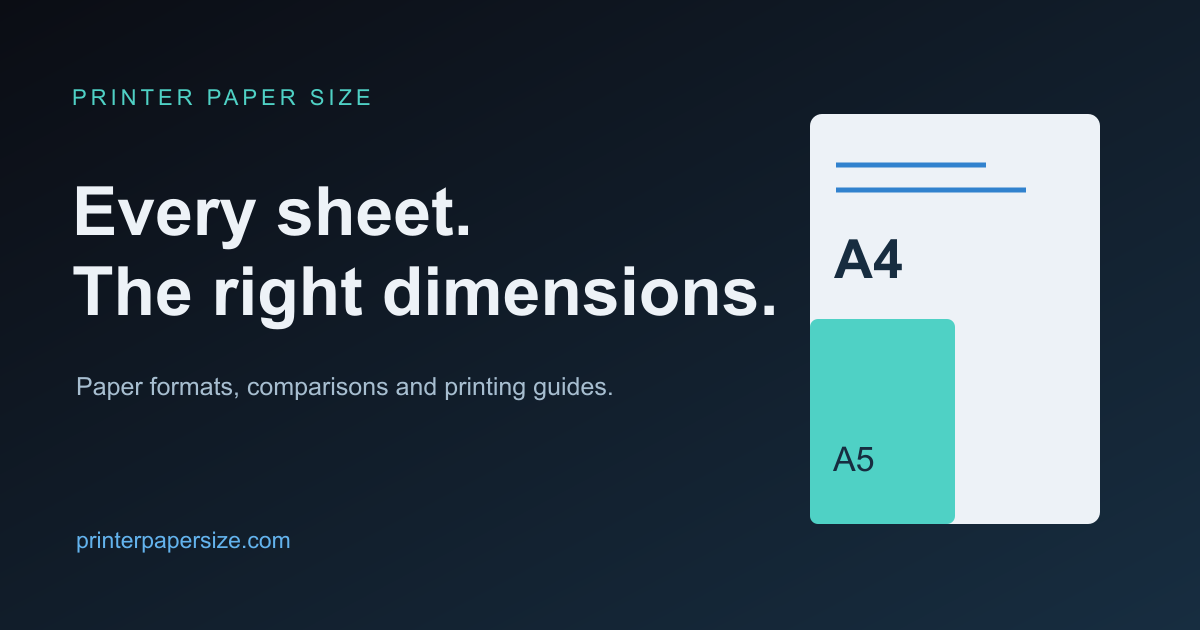
The relationship between A3 paper (297 × 420 mm) and A4 paper (210 × 297 mm) forms the backbone of international document printing and commercial publication layout. Because ISO 216 paper sizes share a consistent aspect ratio of 1:√2 (approximately 1:1.414), halving an A3 sheet along its length yields two proportional A4 sheets.
2-Up Layout and Booklet Imposition
An A3 sheet in landscape orientation exactly accommodates two portrait A4 pages side by side. This property is central to booklet production:
- Spreads and Booklets: Two facing A4 pages can be printed onto a single A3 sheet and folded down the center to produce an A4 booklet.
- Bleed and Crop Marks: A finished A3 sheet measures 297 × 420 mm, which does not include extra margin for bleed or trim marks. Commercial printers therefore use oversized stock like SRA3 (320 × 450 mm) or A3+ so that full-bleed A4 spreads can be printed and trimmed cleanly.
Accurate Scaling Math
When converting artwork between A4 and A3:
- Enlarging from A4 to A3: The linear scale factor is 141.4% (the square root of 2), not 200%. Doubling both dimensions would quadruple the surface area rather than doubling it.
- Reducing from A3 to A4: The linear scale factor is 70.7% (1/√2).
Compare live overlay previews, aspect ratios, and scaling percentages in our A4 vs A3 comparison tool or check other sheet relationships with the paper size comparison tool.